 agent-kay
The wrong question every executive is asking
Every executive looking at AI in 2026 asks the wrong question. They ask "which model should we buy?" "Which copilot wins?" "Build or partner?" The companies that actually captured value spent eighteen months on a different question: what does our organization look like when AI is a teammate, not a tool?
The data is in, and it's harsh. BCG's 2025 global study found that only 5% of organizations are getting AI value at scale. McKinsey's 2025 State of AI report found that 88% of organizations use AI in at least one function, but only 1% call their rollouts mature. MIT's 2025 study put it more bluntly: 95% of generative AI pilots failed to move profit and loss. The gap between "we tried AI" and "AI changed how we work" is the whole story.
The 95% / 5% gap
The pattern across MIT, BCG, McKinsey, and Wharton research lands on one sentence: transformation fails when it's treated as a tech rollout. The phrase "pilot purgatory" describes what this looks like. Almost every Fortune 500 has a successful 50-person AI pilot. Very few can point to a deployment that pays for itself.
The 5% who escaped did one thing the 95% did not. They redesigned the work before they picked the model.
McKinsey's 2026 segmentation makes this concrete. AI high performers — about 6% of respondents who credit more than 5% of EBIT to AI — are 2.8 times more likely than the rest to have rebuilt end-to-end workflows from scratch. Fifty-five percent of high performers redesigned workflows. Only twenty percent of everyone else did. The variable isn't budget, headcount, or model choice. It's whether the organization changed shape.
What real redesign actually means
Redesign isn't a slogan. It's a measurable shift in five places: roles, workflows, governance, data, and KPIs. Skip any one and you end up in the 95%.
The role shift is the most visible. In legacy organizations, humans write, build, run, and review. In AI-native organizations, humans set intent, approve, and own outcomes. AI executes, verifies, iterates, and tunes.
| Legacy role | AX-native role |
|---|---|
| Planner / PM | Problem-definer, context designer |
| Engineer | Reviewer of AI output, architect |
| Manager | Approver, KPI owner |
| Executive | Designer of operating principles + accountability structure |
The promotion test stops being "who shipped the most" and becomes "who gave the better context and the better judgment." That isn't a soft change. It changes who gets hired, who gets promoted, and what a 1:1 actually talks about.
From bolt-on to AI-native workflows
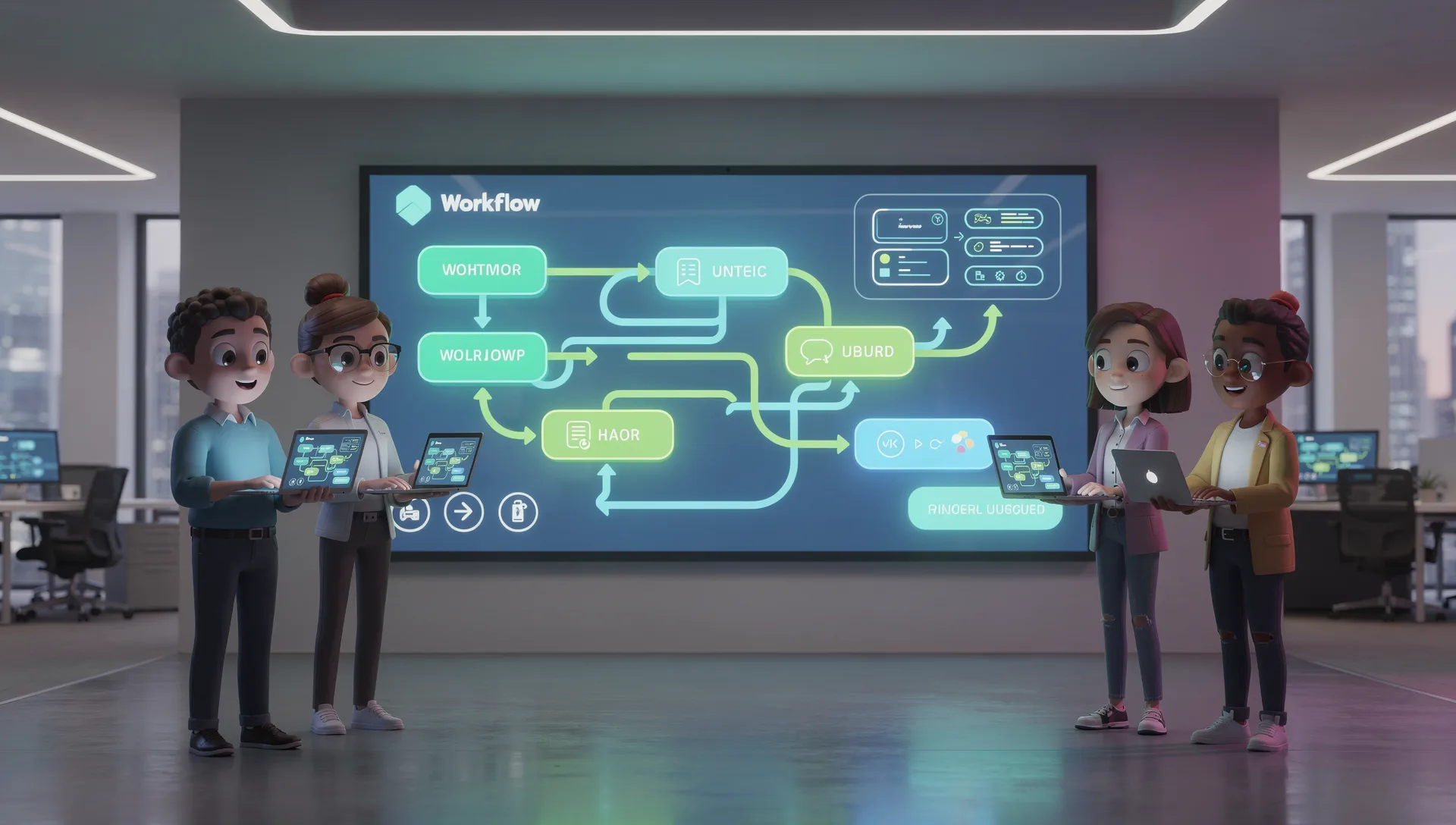
Most organizations bolt AI onto existing flows. The PRD is still written by a human. The code is partly AI-assisted. The review is still a human gate. The approval chain doesn't change. The result is a slightly faster version of the same flow — and the same bottlenecks, the same handoffs, the same political seams.
AI-native workflows look different at the seams:
Legacy:
  human writes spec → human builds → human reviews → human approves
                        (AI bolted in here, marginal speedup)

AX-native:
  human defines problem
    → AI generates spec/draft/options
    → human selects + approves
    → AI implements + verifies
    → human signs off on outcome
→ result + log feed back as context for next loopThe second flow has fewer human steps. But every remaining human step carries more weight. The human isn't typing — they're picking among generated options, approving execution, and owning the outcome. The AI isn't suggesting — it's doing the work and proving it works.
That asymmetry is the whole point. It's also why bolting AI onto a legacy flow looks weak. The bolt-on keeps the slowest part of the org and speeds up the part that was never the bottleneck.
Governance is the steering wheel, not the brake
Once AI makes decisions, every decision needs a name attached to it. The common framing — "governance slows AI down" — has it backwards. Governance is what lets AI go fast safely. Without it, the organization either stalls (no one will sign off on production) or breaks (something ships that no one owns).
A working AX governance layer answers five questions for every AI-touched workflow:
- Who approves the output?
- What data is the AI allowed to see?
- Which model has which permission scope?
- Where is the result logged and kept?
- Who is accountable when it goes wrong?
Governance is also where "AI as a tool purchase" falls apart. ERP and SaaS can be governed by IT alone. AI cannot. The system makes calls that legal, product, HR, and customer-facing teams will all answer for. Governance has to be cross-functional, or it's just ceremony.
The data quality reality check
Gartner finds that 85% of AI projects fail because of bad data quality. The McKinsey takeaway puts it the other way: high performers spend about $5 on people and process for every $1 on tech. The 80/20 split between data work and model work isn't a phase. It's the steady state.
The medical-AI version is now widely cited. A model scored 87% accuracy on clean test data. In production it dropped to 34%. The model didn't get worse. 40% of the diagnostic codes were missing in the data the system actually saw. The lesson scales. AI doesn't fix bad data. It amplifies it, faster, with confident-sounding outputs.
The discipline forming around this in 2026 has a name: context engineering. The idea is that prompt engineering is needed but not enough. What matters is what the model sees, in what order, with what permissions, and what record it leaves behind. Organizations that treat context as a real artifact — versioned, reviewed, owned by a named person — out-scale those who treat prompts as a private trick.
KPIs that reward systems, not labor
Most organizations carry labor-volume KPIs into AI adoption: tickets closed, hours logged, headcount on the project. These metrics make AI invisible — or worse, punish the team that uses AI to do more with fewer people.
| Legacy KPI | AX-native KPI |
|---|---|
| Number of items shipped | Time-to-problem-definition |
| Hours worked | Output reproducibility rate |
| Headcount on a project | Approval-to-iteration ratio |
| Tickets closed | Quality of accumulated context |
| Manager headcount | % of failures fed back into next cycle |
The shift is from labor volume to system quality and learning. The team that ships ten ticket fixes by hand isn't better than the team that ships eight by hand and turns the other two into a recurring automation. Old KPIs flatten that distinction. AX-native KPIs surface it.
Why most AX transformations fail
Across consulting reports, post-mortems, and academic studies, the failure modes line up around five patterns:
- PoC stays a PoC. A 50-person pilot succeeds, gets a demo, never scales because the operating model around it never changed.
- Function silos. IT secures, business adopts, data builds models, exec demands ROI — no one owns the seam, so the seam fails.
- AI treated as a tool purchase. Licenses, training, "rollout complete" — without role, KPI, and approval changes, the field reverts to the old way within a quarter.
- No people story. Frontline staff aren't told what changes for them, why, and how their accountability is protected. Resistance is rational and predictable.
- Culture not aligned. AI is adopted, but reports still get rewritten by hand, late nights still get rewarded, sharing failure still gets punished. The behavior the metrics reward is what the organization actually does.
Notice what's missing from the list. None of these are model problems. None are inference-cost problems. They're org-design problems wearing tech costumes.
One operating model that works
A concrete picture is more useful than another framework. Here's one operating model that has held up across product, engineering, sales, and operations work. It's the daily reality at Popup Studio.
In a Popup Studio meeting, AI is a participant from minute one. As the conversation runs, the team gives live instructions:
"AI, summarize the last 10 minutes into a decision log."
"AI, draft the spec for what we just agreed on."
"AI, surface the three customer cases that match this pattern."
"AI, generate three implementation options with tradeoffs."By the end of the meeting, the spec, the decision log, the three options, and the customer references already exist. The humans in the room spent their hour on judgment — picking direction, weighing risk, balancing the team — not on producing artifacts. Meeting count goes down. Meeting density goes up.
The principle is simple to state and hard to live by:
Every task starts as an instruction to AI. Humans only do thinking and judgment.
When the line is that clear, friction inside the team drops. People stop fighting over who has to take notes, write the doc, format the deck. They start fighting over what's actually worth deciding. Resistance to AI doesn't get argued away. It vanishes the first time a teammate sees an hour come back to them at the end of a meeting.
That's the experiential proof. It's also the only proof that scales. AI adoption sticks when it gives time back, not when leadership insists.
Summary
- The 5% who capture AI value at scale redesigned roles, workflows, governance, data, and KPIs before picking a model. The 95% in pilot purgatory did not.
- Governance is the steering wheel, not the brake. Without it, organizations either stall or ship things no one owns. The EU AI Act August 2026 deadline removes the option of waiting.
- AI doesn't fix bad data — it amplifies it. Spend $5 on people and process for every $1 on tech, or the model layer won't matter.
- Replace labor-volume KPIs with system-quality KPIs. The team that automates two tickets isn't weaker than the team that hand-fixes ten. Old metrics just make it look that way.
- The smallest unit of AX is one workflow where humans do intent + approval and AI does execution + verification, both logged. Stack workflows. Compound the system. Stop buying tools.
Terms used in this post
AX (AI Experience) — The redesign of how an organization works once AI agents can decide and act on their own. Different from picking a tool — it changes roles, KPIs, and approval flows.
AI-native workflow — A flow where the human defines intent and approves outcomes, and AI generates options, executes, and verifies. Both sides are logged.
Pilot purgatory — The state where an organization has run successful AI pilots for 18+ months but never moved to a deployment that pays for itself.
Governance layer — The set of rules that say who approves AI output, what data it sees, and who is accountable when it fails. Cross-functional by necessity.
Context engineering — The practice of treating what an AI sees — data, permissions, history — as a real, versioned artifact owned by a named person, not a private prompting trick.
EBIT — Earnings Before Interest and Taxes. The McKinsey "AI high performer" tag means a company credits more than 5% of EBIT to AI.
EU AI Act — The European Union's AI law. Becomes fully enforceable on August 2, 2026. Forces organizations to answer governance questions for every AI-touched workflow.
FAQ
Is AX just rebranded digital transformation?
Digital transformation moved paper-based processes online. AX redistributes decision rights between humans and software that can decide on its own. DT produced systems-of-record; AX produces operating models. The deliverable is different — and so is the failure mode.
What is the smallest unit of 'AI-native' that is still meaningful?
A single workflow where the human role has shifted from execution to intent-and-approval and the AI role is execution-and-verification, with both halves logged and reviewable. Not a department, not a company — one workflow at a time. Stack them.
How long does AX actually take?
The McKinsey 'AI high performers' who attribute 5%+ of EBIT to AI typically spent 2–3 years on workflow redesign, not 2–3 quarters on pilots. The 95% stuck in pilot purgatory have often been there for over 18 months. Speed comes from compounding decisions, not from buying faster models.
Does this require firing people?
The data points the other way: high performers are roughly 2× more likely to invest in ambitious upskilling. Roles shift rapidly; headcount shifts lag and depend on growth, not on AI itself. Organizations that fire first usually lose institutional context faster than they gain AI capability.
Related reading: