 agent-kay
AI is the new discovery gate
You shipped your app on a Friday afternoon. Monday morning, a stranger types "best CLI for managing API keys" into Claude. The answer names three tools. Yours isn't one of them. The AI didn't know about you yet.
This is the new acquisition funnel for vibe coders. Discovery, interest, desire, purchase — the same four stages we've always had. But the gate at the front used to be Google. Now, for a growing slice of users, it's a chat box that picks three names. If you don't get picked, you don't exist.
SEO got pages indexed. AEO — Answer Engine Optimization — gets your product cited inside the answer itself. The job is no longer to rank fourth on a search results page. The job is to be one of the names the AI types.
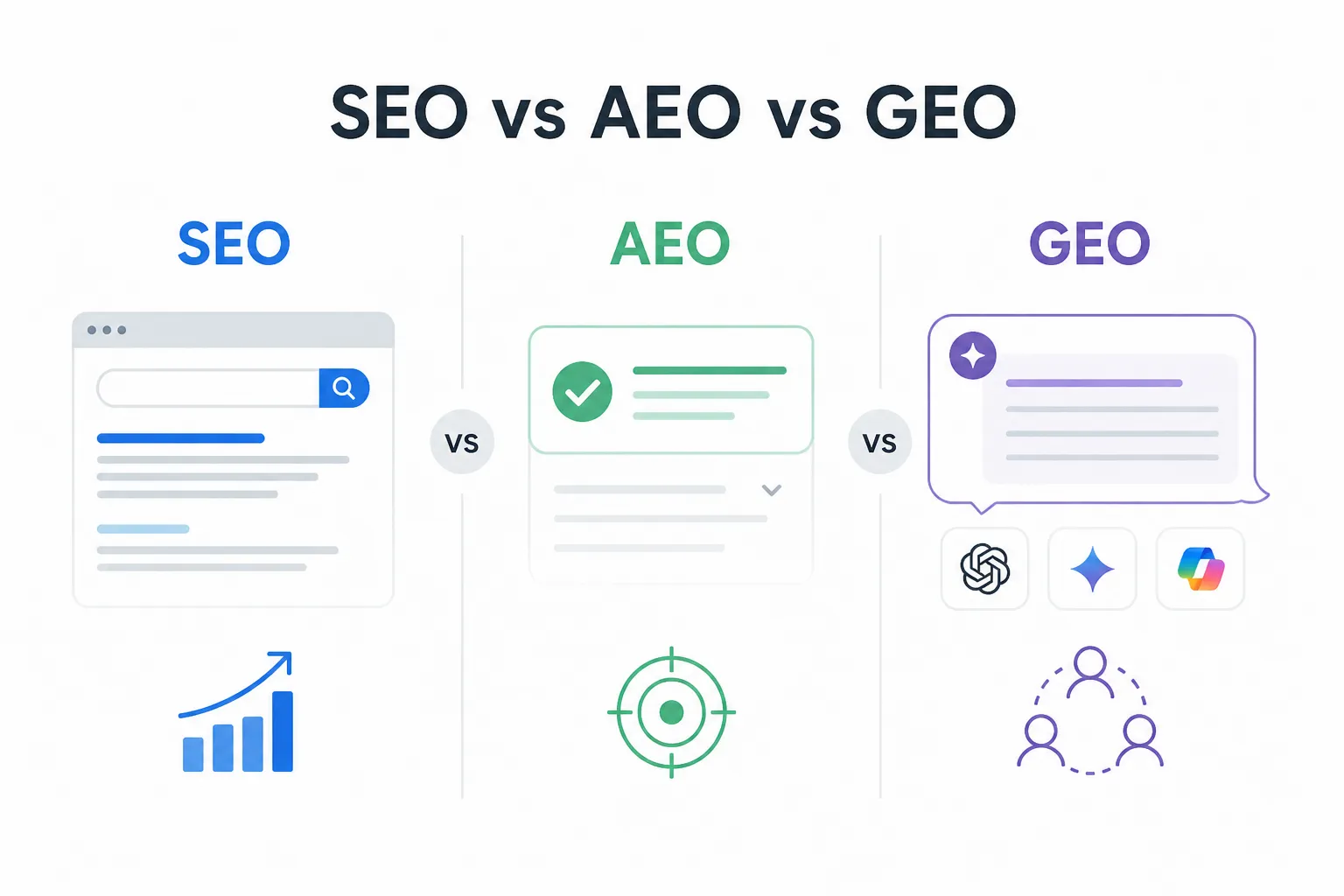
| SEO | AEO | |
|---|---|---|
| Goal | Rank a URL | Get cited in an answer |
| Actor | Ranking algorithm | Language model |
| Format | Blue link, snippet | A sentence, a name, sometimes a footnote |
| Measure | Position, CTR | Share of Voice, citation rate |
| Asset | Page | Page + structured data + brand mentions + MCP server |
The two overlap. A page that ranks well on Bing also gets fed to ChatGPT. But you can't stop at ranking. You also have to make the page easy for an LLM to cite — short, sourced, structured.
Where each AI assistant actually searches
Real-time AI answers come from a small set of indexes. Knowing which one sits behind each assistant tells you exactly where to submit your sitemap.
| Assistant | Live retrieval source |
|---|---|
| ChatGPT (with search) | Bing index + OpenAI's own crawler |
| Claude.ai web search | Brave Search API |
Claude Code (WebFetch) | Direct HTTP fetch to a URL the model picks |
| Perplexity | Google-derived SERP + Sonar's own ranker |
| Gemini / AI Overviews | Google index (via Google-Extended) |
| GitHub Copilot Chat | Bing-class web search |
| Brave Leo | Brave Search index |
Two practical things follow from that table.
First, Bing is the choke point for ChatGPT. Seer Interactive measured 87% of SearchGPT citations matching Bing's top-five results in 2025. If Bing Webmaster Tools doesn't show your sitemap, ChatGPT can't see you no matter how clean your JSON-LD is.
Second, Brave matters for Claude. Anthropic uses the Brave Search API behind the scenes for claude.ai's web search; the parameter names were confirmed by both TechCrunch and independent observers in early 2025.
Submitting to Bing Webmaster Tools is a five-minute job most vibe coders skip because they only know Google Search Console. Don't skip it.
Two clocks: retrieval-time vs training-time
Tactics fall on two different clocks. Confusing them is the most common AEO mistake.
Retrieval-time is what happens this week. ChatGPT searches Bing. Claude searches Brave. Perplexity reads the SERP. If your page is on those indexes, the AI can find it for the next prompt. Visibility arrives in days and disappears the same way — one indexing hiccup and you vanish.
Training-time is what happens 6 to 18 months from now, when the next model is trained. The crawl behind that model — Common Crawl, GitHub, Wikipedia, Reddit, Stack Overflow — gets baked into the weights. Once it's in, the model "knows" your product without searching for it.
You need both. Retrieval gives you fast, fragile visibility. Training gives you slow, sticky visibility that keeps working even when the user has search turned off.
30-minute baseline: structured data, sitemaps, llms.txt
Three things you can ship in a single coffee break.
JSON-LD structured data. Add SoftwareApplication, FAQPage, and
Organization to your landing page. AI search systems parse these to
understand what your site is, what it does, and what questions it
answers. Google's own data shows pages with FAQ markup are 3.2 times
more likely to appear in AI Overviews — keep each answer between 40
and 60 words.
{
  "@context": "https://schema.org",
  "@type": "SoftwareApplication",
  "name": "tene",
  "applicationCategory": "DeveloperApplication",
  "operatingSystem": "macOS, Linux, Windows",
  "offers": { "@type": "Offer", "price": "0" },
  "description": "Local-first secret manager. Encrypted vault, no server."
}Drop that into a <script type="application/ld+json"> tag. Validate
it with Google's Rich Results Test before shipping.
Sitemap submission. Submit /sitemap.xml to:
- Bing Webmaster Tools (this is the one that feeds ChatGPT)
- Google Search Console (for Gemini and AI Overviews)
- IndexNow (a one-time ping that notifies Bing, Yandex, and others)
llms.txt as cheap insurance. Drop a markdown manifest at
/llms.txt that summarizes your site for LLMs. Adoption is wide —
BuiltWith tracks more than 800 thousand sites including Anthropic and
Cloudflare — but no major provider has confirmed they actually fetch
it. Treat it as a 30-minute defensive move, not a growth lever.
# tene

> Local-first secret manager. Encrypted on disk with XChaCha20-Poly1305.

## Docs
- [Quickstart](https://tene.sh/docs/quickstart): One-command install
- [Concepts](https://tene.sh/docs/concepts): Vault, env, recovery key
- [CLI reference](https://tene.sh/docs/cli): Every command and flagGEO-rewrite your hero pages
A 2024 paper from Princeton, "GEO: Generative Engine Optimization" (Aggarwal et al.), measured what actually moves the needle for getting cited inside a generated answer. The results, by visibility lift over a no-edit baseline:
| Tactic | Lift |
|---|---|
| Add direct quotes from credible sources | +41% |
| Add concrete statistics and numbers | +33% |
| Cite sources inline | +28% |
| Improve fluency (shorter, clearer prose) | +28% |
| Use relevant technical terms | +18% |
| Keyword stuffing | −8% |
Rewrite your three best-performing posts with this checklist:
- Every claim that could be doubted gets a direct quote from a primary source.
- Every "many users" or "most teams" gets replaced with a specific number.
- Every paragraph that can be shorter, gets shorter.
- Cut the LLM-tells: words like "robust", "comprehensive", and "leverage" hurt your fluency score.
Before:
Modern AI tools leverage robust retrieval to facilitate seamless answers across diverse use cases.
After:
The 2024 Princeton GEO paper measured a 41% lift when pages add direct quotes from credible sources. Adding inline citations is the single biggest change you can make to a page.
The "after" version reads cleaner and scores higher on every GEO factor.
Brand mention seeding for the next training cycle
AI training corpora pull from a small set of sources, weighted by quality. RedPajama-V2, an open replica of LLaMA's training mix, gives a usable proxy for which sources matter most:
- GitHub: 60 billion tokens
- arXiv: 28 billion
- Books: 26 billion
- Wikipedia: 24 billion
- Stack Exchange: 20 billion
- Common Crawl: 878 billion (lower per-token quality)
Translation: a single high-quality GitHub README, Stack Overflow answer, or Wikipedia mention is worth more per token than a hundred marketing pages buried in CommonCrawl. For a solo vibe coder, the practical seeding plan:
- Submit a PR to two or three relevant
awesome-*lists. One link, one line — gets indexed by both the GitHub corpus and Bing. - Post a thoughtful Show HN that explains the idea, not the product. Front page is a bonus; HN gets crawled either way.
- Find one Stack Overflow question where your tool is genuinely the answer. Write a 200-word reply. Link only once.
- Do an honest AMA in a target subreddit (r/cursor, r/selfhosted, r/golang — pick the one that matches your product).
Wikipedia is the highest-weight surface per token. It's also the one that will most ruthlessly revert a self-promotional edit. Only push for a mention there when your product is genuinely notable.
Ship an MCP server (if your product is tool-shaped)
The Model Context Protocol is a standard for connecting AI assistants to external tools. The official MCP Registry launched in September 2025. Subregistries — Smithery, PulseMCP, mcp.so, the Anthropic Desktop directory — federate from it.
For tool-shaped products (CLIs, dev utilities, internal APIs), getting listed in the registry is the closest thing to an App Store entry for AI assistants. Once registered, a Claude Desktop or Cursor user can install your tool with one command.
npx -y @modelcontextprotocol/create-server my-tool
mcp publishThe verification step uses GitHub login or DNS challenge, so impersonation is hard. If your product can be wrapped in an MCP server in a weekend, this is the single biggest AEO move available right now.
Measure with a monthly prompt panel
You can't optimize what you don't measure. Two paths:
Free DIY. Pick 20 prompts a target user might type. Run them once a month against ChatGPT, Claude, Perplexity, Gemini, and Brave Leo. For each prompt, log: did your product get mentioned, in what position, and alongside which competitors. A single Google Sheet does this fine.
prompt: "Best CLI for storing API keys locally"
- ChatGPT:    pass-1 miss   pass-2 hit (position 3 of 5)
- Claude.ai:  hit (position 1)
- Perplexity: miss
- Gemini:     miss
- Brave Leo: hit (position 2)Paid tools. Profound, AthenaHQ, Peec.ai, and Otterly all track Share of Voice across the major assistants. They're priced for teams, not solo founders, but worth the free trial once you cross product-market fit.
Watch the trend, not the number. A week of bad results doesn't mean your tactics failed — retrieval indexes recrawl on their own clock.
Don't backfire
Black hat AEO is real and largely punished. Skip these:
The pattern: the tactics that work for AEO are mostly the same ones that work for being a good citizen of the open web. Cite well. Quantify. Be findable. Don't game.
Summary
- AI assistants pull from different live indexes — Bing for ChatGPT, Brave for Claude, Google for Gemini. Submit your sitemap to all three.
- JSON-LD, FAQ schema, and structured data are the cheapest 30-minute lift you can ship today.
- Princeton's GEO paper shows the recipe: cite, quantify, soften your prose. Skip keyword stuffing — it's measurably negative.
- Brand mentions on GitHub, Stack Overflow, Wikipedia, and Hacker News compound into the next training cycle.
- For tool-shaped products, an MCP server in the official registry is the highest-impact AEO move available.
- Measure with a monthly prompt panel. Optimize the trend, not single results.
Terms used in this post
AEO (Answer Engine Optimization) — Making your product likely to be named inside an AI's generated answer. Different from SEO, which ranks a page on a search results screen.
GEO (Generative Engine Optimization) — A research term, often used as a synonym for AEO. The Princeton paper of the same name first measured what actually moves citation rate.
JSON-LD — A way of writing Schema.org structured data as JSON
inside a <script> tag. Search engines and LLMs parse it to understand
your page.
llms.txt — A proposed markdown manifest at the root of your site, summarizing your content for LLMs. Adoption is wide; provider commitment to actually fetch it is unclear.
MCP (Model Context Protocol) — A standard from Anthropic for letting AI assistants call external tools. Each tool runs as an MCP server.
RedPajama — An open replica of the LLaMA training dataset. Its public token weights tell us roughly which web sources matter most for training.
Retrieval-time vs training-time — Two different clocks for AI visibility. Retrieval is what an assistant searches the web for right now. Training is what gets baked into the next model release.
Share of Voice — In AEO measurement, the percentage of relevant prompts where your brand gets mentioned by name.
FAQ
Is AEO just SEO renamed?
No. SEO ranks pages for keywords. AEO gets your product named inside an AI's generated answer. Different actor (a language model, not a ranking algorithm), different format (a sentence, not a blue link), different way to measure (Share of Voice across prompts, not position on a SERP).
My product is brand new. Won't AI ignore it because of the training cutoff?
For real-time retrieval, no. ChatGPT search, Claude.ai's web search, and Perplexity all read the web for every answer. Optimize those paths first. Training-cutoff visibility comes later, on a 6 to 18 month clock as new models get released.
Do AI assistants actually fetch /llms.txt?
No major provider has confirmed it as of mid-2026. Adoption is wide (Anthropic, Cloudflare, Mintlify all publish one), but the actual fetch behavior is unproven. Treat llms.txt as a 30-minute defensive move, not a strategy. Most of the win comes from JSON-LD, FAQ markup, and getting indexed by Bing.
Should I block AI crawlers in robots.txt?
Probably not. You'd be closing the door you want open. Perplexity ignores robots.txt anyway, so blocking only hurts the providers that respect the rules. If you must block, block the training-only crawlers (GPTBot, Google-Extended) and keep the search-only ones (OAI-SearchBot) allowed.
Related reading: